The clinical problem
A doctor may have a registration slip, handwritten findings, laboratory reports and imaging results in separate places. Connecting these records would make it easier to understand the current picture and see how it has changed during the visit.
What “module” means here
A module is one part of the hospital system responsible for a particular task. The proposed design has six parts:
- Registration: patient identity and the reason for seeking care.
- Vital signs: measurements, their time and their source.
- Clinical examination: history, examination findings and the doctor’s working diagnosis.
- Laboratory investigations: blood-test results and relevant reports.
- Histopathology: tissue and biopsy reports when indicated.
- Radiology: imaging reports and access to the relevant images.
The proposed record flow
This diagram shows how information could connect. It is not a mandatory sequence of investigations.
Registration
Patient identity and reason for attendance.
Registration prototypeRecorded vital signs
Measurements linked to the patient, with source and time.
Kiosk proposalClinical assessment
History, examination and the doctor’s working diagnosis.
Examination templatesLaboratory results
Relevant test results, reviewed in clinical context.
Example data structureHistopathology
Tissue or biopsy reports when indicated.
Future componentRadiology
Relevant imaging reports and images.
Future componentCombined clinical view
Available findings and reports brought together for review.
Proposed connectionDoctor’s assessment
The clinician reviews the available information and records the diagnosis and plan.
Clinical responsibilityWhat the doctor should see
The proposed combined view would show the clinical findings alongside the available reports. It should preserve earlier working diagnoses and record the doctor’s later assessment, rather than repeatedly overwriting one diagnosis field.
The diagram shows a teaching sequence. It does not mean that all patients need all investigations, or that tests must be ordered in that order. Clinical need determines the sequence.
Why structured entries help
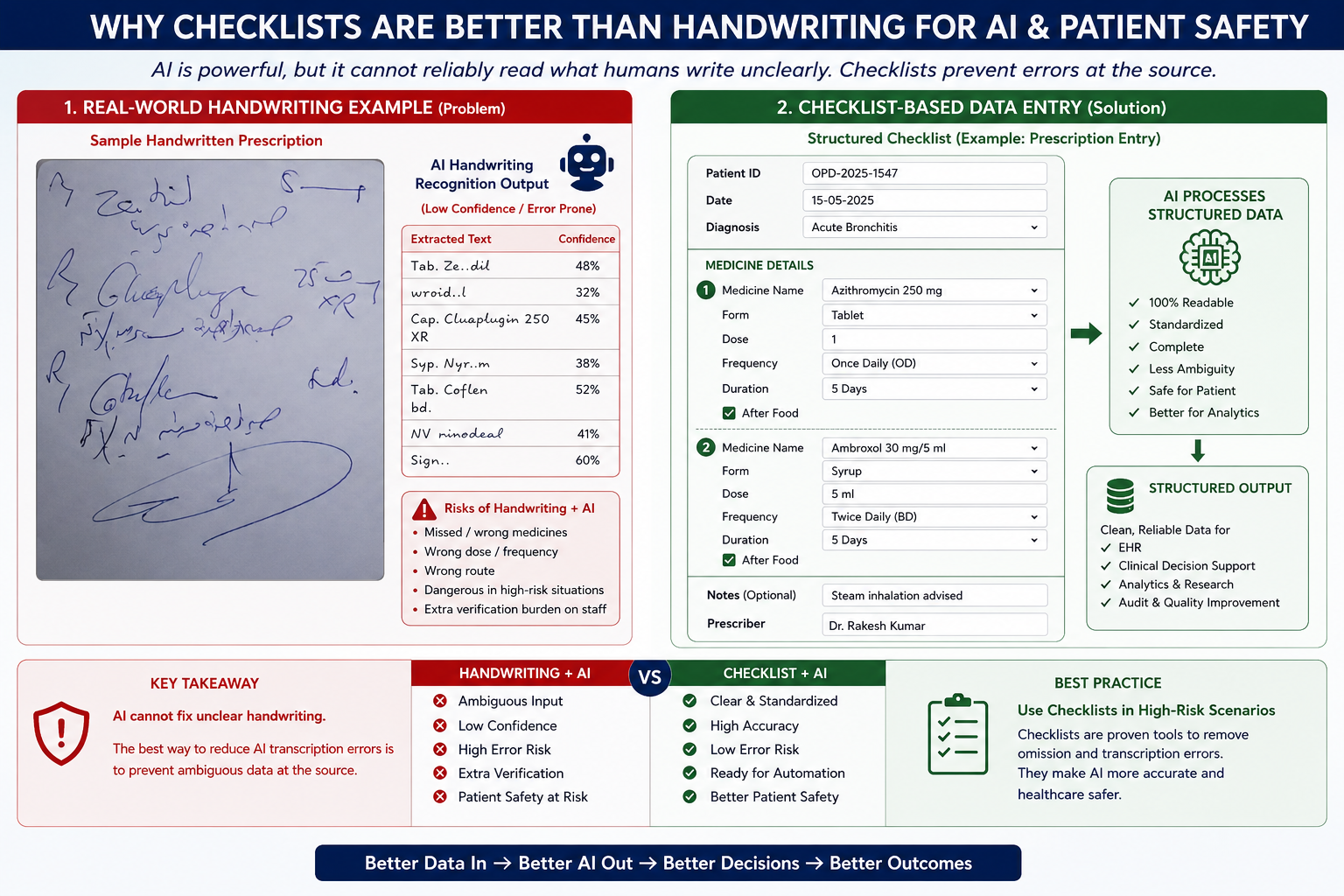
A labelled field for a measurement, medicine or examination finding makes it easier to search and compare records. It also reduces the need to interpret handwriting later. However, a dropdown can still contain the wrong selection. Structured fields need clinical review and space for observations that do not fit a preset list.
The checklist comparison graphic is an illustration of this design idea. Its percentages and safety statements are not performance results from these projects.
What exists and what is proposed
The collection contains separate registration and examination prototypes and a sample combined dataset. The vitals kiosk is a proposal. The histopathology and radiology components in this architecture are future components; this page does not demonstrate a connected hospital deployment.
Project diagrams and sample outputs