The clinical problem
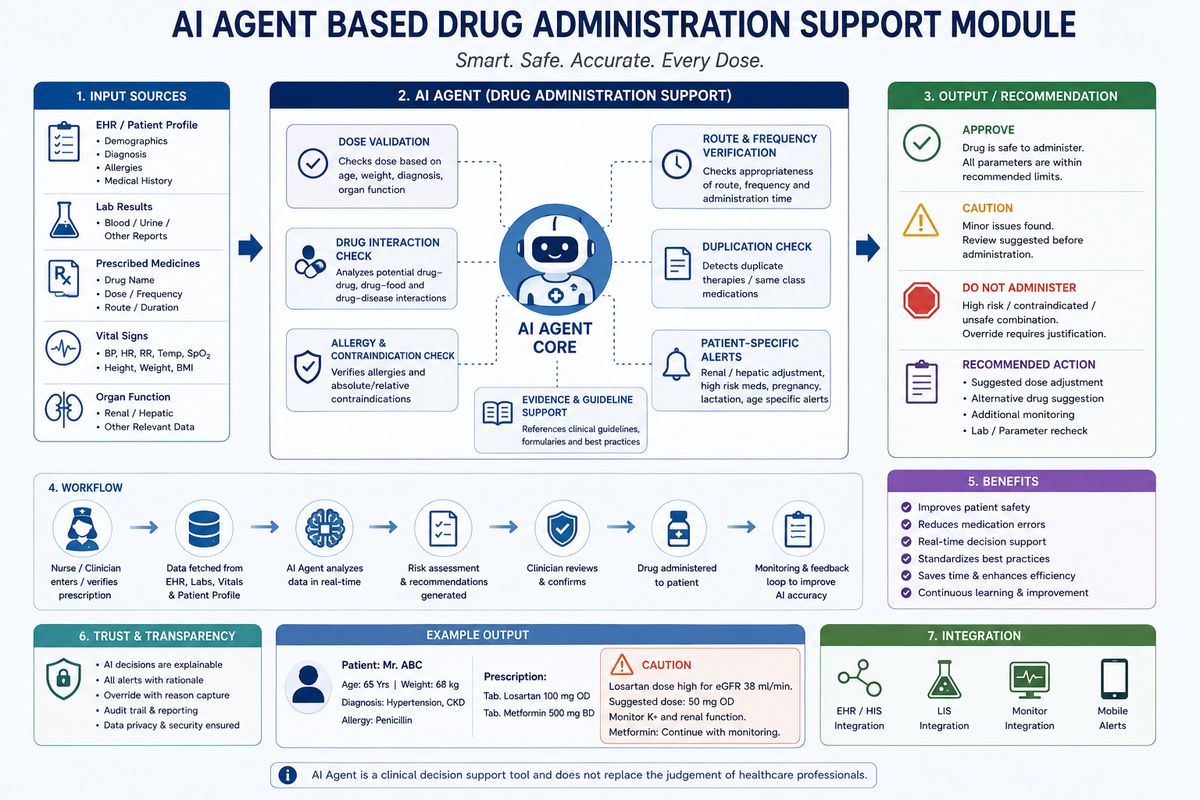
A prescription needs to be considered alongside the patient’s allergies, other medicines, relevant observations and investigation results. Information spread across separate records can make that review harder. This proposal brings those inputs into one review process.
What information would be needed?
- The doctor’s prescription: medicine, dose, route, frequency and duration.
- The patient’s recorded allergies and current medicine list.
- Relevant age, weight, diagnosis and clinical context.
- Available laboratory results, including information relevant to renal or hepatic function.
- The time and source of the data used for each check.
What the proposed checks would cover
The proposed checks include dose questions, interactions, allergies, contraindications, duplicate therapy, route and frequency, and monitoring requirements. A useful alert would explain what triggered it and identify the information or reference that needs review.
What the care team would see
- No issue identified by the configured checks: this does not certify that a prescription is safe or complete.
- Review required: a possible problem or missing information needs clinical assessment.
- High-priority alert: bring the flagged concern to the responsible clinician through the hospital’s medication workflow.
An illustrative example
A newly entered medicine appears to conflict with an allergy entry. The proposed system would display the medicine, the recorded allergy and the reason for the alert. The care team would verify the history and prescription and document the decision. This example illustrates the workflow; it does not recommend a medicine or dose.
The proposed sequence
- Enter and verify the prescription.
- Bring together the relevant patient information.
- Run the configured checks and present the findings.
- Have the responsible clinician review the concerns and document the decision.
- Follow the hospital’s administration and monitoring procedures.
Current scope
This is a proposed clinical decision-support system, not a working medication-safety certification tool. Connections to hospital and laboratory systems, reliable drug references, alert evaluation and audit records would need to be implemented and assessed. Improvements should be evaluated through a controlled process; the model should not silently change its clinical behaviour after each case.
Project diagrams and sample outputs