What is an AI agent?
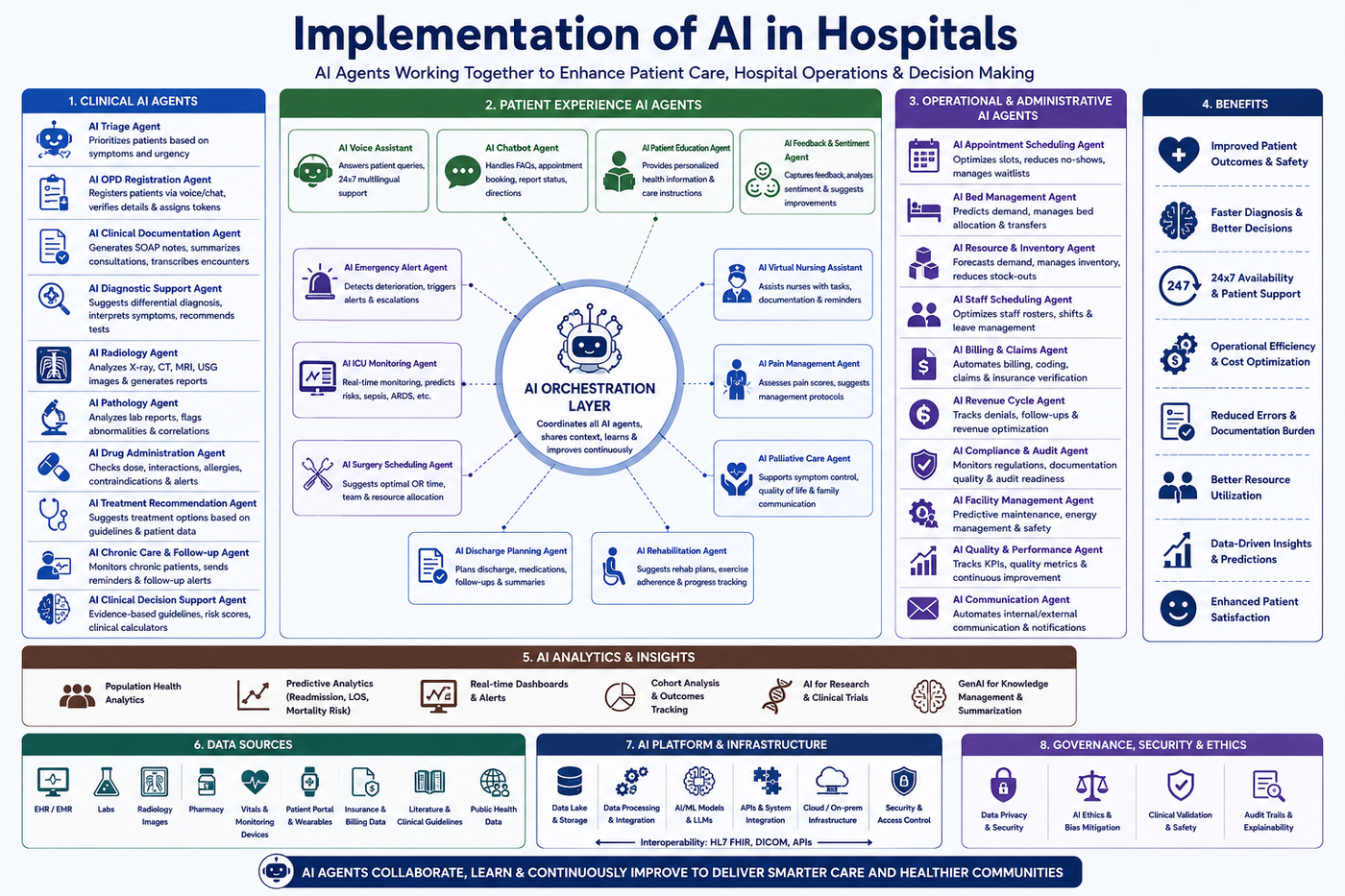
In this proposal, an agent is a software assistant assigned a defined task, such as preparing a draft note or checking whether a report is ready. The diagram maps possible roles across a hospital. It is a planning view, not a list of deployed services.
Clinical assistants: work around the consultation
- Intake and documentation: organise the presenting complaint, assist registration and prepare draft notes for review.
- Diagnostic and investigation support: bring together findings and assist review of possible diagnoses, imaging or pathology outputs within an evaluated role.
- Medicines and treatment: flag prescription questions and retrieve relevant guidance for the clinician.
- Follow-up and decision support: organise reminders, recorded observations, calculators and review tasks.
Patient-facing and ward assistants
Possible roles include answering service questions, explaining appointment or report status, preparing patient information and collecting feedback. The original map also includes nursing tasks, deterioration alerts, ICU monitoring, surgery scheduling, discharge, rehabilitation, pain and palliative-care support.
These roles have different levels of clinical responsibility. A directions assistant and a deterioration-alert system cannot be evaluated or supervised in the same way. Each would need a defined purpose and an appropriate human escalation route.
Operational assistants: support the hospital team
The proposed administrative roles cover appointments and waiting lists, beds and transfers, stock and equipment, staff rosters, billing and claims, audits, maintenance, quality measures and communication. Their value would depend on reliable information and a workflow that staff can actually use.
How the assistants would connect
The diagram calls the coordinating component an orchestration layer. In plain language, this is the part that passes an authorised task and relevant context to the right assistant, records what happened and routes the result to the responsible person.
The underlying information would come from clinical records, laboratories, imaging, pharmacy, monitoring devices and other hospital services. FHIR refers to standards for exchanging health-record information; DICOM is used for medical images and related information. An API is a defined way for software systems to exchange information. Naming these standards does not mean the connections have been built.
Where doctors should begin
- Choose one clearly defined problem, such as a missing-result handover or a draft-note review.
- Agree what the assistant may do and who checks the output.
- Identify the information it needs and whether that information is reliable.
- Test the workflow and measure errors, workload and usefulness.
- Expand only after the team understands the results and limitations.
Current scope and expected value
The diagram brings together proposed clinical, patient-service and operational roles, along with analytics, research and knowledge-management possibilities. Privacy, access controls, clinical evaluation, explanations and audit records are requirements for implementation, not outcomes established by this page.
Reduced workload, better coordination and improved care are aims to evaluate. This collection does not establish those benefits or demonstrate a complete hospital-wide agent system.
Project diagrams and sample outputs